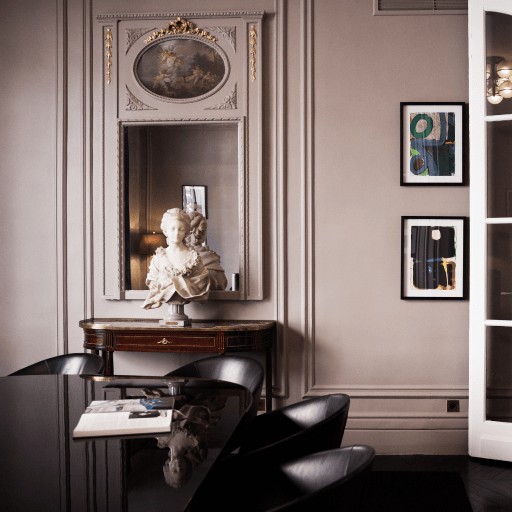
WHEN MODERN ART MEETS HAUSSMANN ELEGANCE
Categories : Our Hotel, published on : 1/28/26
In the heart of the 8th arrondissement, Hôtel Vernet embodies an address where the dialogue between heritage and contemporary creation is expressed with rare precision. Behind a Haussmann façade defined by balanced lines, the hotel reveals a vision of design conceived as continuity rather than contrast. Mouldings, stone and light form a strong historical structure upon which works of art and bold modern choices are seamlessly layered. At 25 rue Vernet, each space is designed as a complete composition, where materials, volumes and artistic creations align to offer a coherent aesthetic experience, reflecting a Parisian art of living reinterpreted with discernment.
HOTEL VERNET, A PARISIAN ADDRESS
at the heart of the golden triangle
Hôtel Vernet is set within a prestigious geography, Paris 8, the Champs Élysées axis, in close proximity to the great avenues and iconic maisons of the district. This location, both central and discreet, shapes the identity of the hotel, a five star establishment conceived as an urban refuge, where calm and intimacy coexist with the energy of the capital.
Beyond its address, the hotel lays claim to a history dating back to 1913, a founding milestone that anchors the property within the architectural narrative of early twentieth century Paris. A member of the B Signature Hotels group, Hôtel Vernet affirms a vision of luxury rooted in refinement, authenticity and the excellence of craftsmanship.
HAUSSMANN CODES
a foundational elegance
To evoke Haussmann style is to speak of the art of building Paris, the clarity of volumes, the nobility of materials, the balance between structure and ornament. At Hôtel Vernet, this heritage is never presented as a static backdrop, but as a subtle, almost instinctive presence. The verticality of the spaces, the architectural reading of the façades, the feeling of a Parisian residence built to endure, all permeate the hotel with quiet confidence.
The building that houses the hotel, constructed in dressed stone by Albert Joseph Sélonier, a key figure of post Haussmann architecture, situates the address within an exacting Parisian continuity defined by solidity, order and distinction. Yet rather than opting for literal preservation, Hôtel Vernet follows a different path, maintaining the nobility of the setting while infusing it with a contemporary breath. Haussmann elegance thus becomes a living foundation, capable of embracing the sensibilities of the present.
2014
a decisive reinterpretation
The year 2014 marked a major turning point in the hotel’s history. On the occasion of its centenary, an extensive renovation was undertaken, conceived not as a simple update but as a true re writing. Widely praised within design and hospitality circles, this transformation aligns with the tradition of the great houses of the 8th arrondissement while asserting a distinctly contemporary identity.
The guiding principle was clear, contemporary comfort is not measured by accumulation, but by precision of gesture, coherence of choices and attention to detail. Every intervention engages in dialogue with the existing architecture, respecting the original structure with care and intelligence.

FRANCOIS CHAMPSAUR
modernity in dialogue
To orchestrate this metamorphosis, Hôtel Vernet entrusted its artistic direction to François Champsaur. His unmistakable contemporary signature introduces freedom of form and an assertive modernity, without ever disrupting the balance of the place. Inspired by collectors’ interiors, his work gives the hotel the feel of a lived in home, where furniture, artworks and architecture converse naturally.
Geometric lines, noble materials and enveloping volumes form a coherent and intimate whole, never ostentatious. Modernity does not seek effect, it unfolds in continuity, with restraint and discernment.
MATERIALS, LINES AND LIGHT
a sensitive language
The design of Hôtel Vernet stands out for its deeply tactile approach. Wood, brass, marble and glass are selected for their ability to interact with light, capture reflections and warm the volumes. The historic architecture remains the framework, while contemporary design becomes its natural extension, revealing the depth of spaces rather than constraining them.
This attention to textures and lines expresses a clear intention, to create an enveloping universe where modernity feels warm and intuitive.
ART
as the language of place
At Hôtel Vernet, art does not merely adorn the walls, it structures the atmosphere, punctuates movement and gives spaces their emotional depth. In the bar and throughout various areas of the hotel, artistic interventions are signed by creators whose works establish a genuine dialogue with interior architecture.
Jean Michel Alberola, whose ceiling frescoes, drawings and abstract rugs form major graphic elements of the bar and reception areas.
Jean Pierre Bourquin, whose paintings and gouaches subtly punctuate selected walls.
Alain Deswarte, represented through original inks and drawings.
Katrin Bremermann and Gérard Traquandi, whose works on paper bring delicate variations to the visual journey.
Drawing, gouache and engraving were conceived in close connection with interior architecture, in an approach where art becomes an everyday évidence. This artistic presence, discreet yet essential, subtly links architectural heritage with an assured modernity. The hotel thus asserts itself not only as a place of hospitality, but also as a place of culture and sensitivity.
THE GLASS ROOF OF LE V RESTAURANT
a balance between history and modernity
An emblematic symbol of this encounter between past and present, the monumental glass roof of Le V restaurant overlooks the tables with silent majesty. Created by master glassmaker Charles Champigneulle on a framework attributed to Gustave Eiffel, it gives the hotel a singular patrimonial dimension, placing Hôtel Vernet among those rare places where history shapes a unique identity.
Contemporary fittings were designed to accompany its curves, curved leather banquettes, mirrored surfaces and plays of reflection intended to extend the light. Here, modern intervention never competes with heritage, it reveals it.

THE BAR
a place of life and creation
Another emblematic space, the bar illustrates the hotel’s ability to become a true meeting point. The Carrara marble counter designed by François Champsaur engages in dialogue with artworks and graphic elements by Jean Michel Alberola, whose motif unfolds both across the ceiling and within the rug design, creating a strong visual echo between surfaces. Marble, copper and deconstructed lines turn material into language, a way of capturing light and setting it in motion.
The bar thus establishes itself as a space for conversation and creation, where historic architecture hosts a resolutely contemporary scenography.
ROOMS AND SUITES
intimacy as an extension of design
In the rooms and suites, the narrative continues with the same level of exigence. The balance between Haussmann heritage and contemporary design is reflected in the choice of materials, the softness of volumes and the presence of golden details. Cottons, silks, velvets and enveloping forms create a soothing atmosphere where aesthetic comfort meets serenity.
Oak parquet floors, mouldings, Pierre Frey textiles and Carrara marble bathrooms all testify to an attention to durability, use and everyday quality.
A CONTEMPORARY VISION
of parisian luxury
What truly distinguishes Hôtel Vernet, beyond its architectural signatures, is the coherence of its narrative. Here, heritage is never frozen, it invites interpretation. Modernity never seeks effect, but accuracy.
Hôtel Vernet thus offers an exemplary reading of the encounter between modern art and Haussmann elegance, not as a spectacular contrast, but as a subtle conversation, conducted through the discreet language of materials, volumes and light.
